
If you own a home in Yucaipa and you're considering turning it into a rental, you're probably weighing two very different realities at the same time. On one side, there's the appeal of steady monthly income from a valuable asset in a desirable Inland Empire location. On the other, there's the practical burden of leasing, screening, repairs, notices, inspections, and California compliance.
That tension is where most owners get stuck.
A detached home in Yucaipa can perform well as a rental, but it doesn't run itself. The owners who do well over time usually aren't the ones who post a listing and wait. They're the ones who price correctly, document everything, set expectations early, and stay disciplined when tenant issues or maintenance decisions come up.
The Opportunity in Yucaipa House Rentals
A lot of owners arrive at the same decision point in a very ordinary way. They move for work, inherit a property, buy another home, or realize they don't want to sell an appreciating asset yet. The house itself may be in good shape. The location may be strong. What creates hesitation is everything that comes after the tenant moves in.
Yucaipa works well for single-family rentals because many renters looking there want a different lifestyle than an apartment offers. They want a yard, more privacy, garage space, and a neighborhood feel. That matters because a house rental is not just square footage. It's a different product, and it needs to be managed that way.
Owners often underestimate the operational side. Leasing is only the front end. The harder part is making consistent decisions month after month when a repair request comes in, a lease term needs enforcement, or a turnover starts revealing deferred maintenance. That's where a rental can either become a reliable asset or a steady source of friction.
What owners usually worry about first
Most conversations start with three concerns:
- Income stability. Owners want to know whether the rent will justify keeping the property.
- Tenant quality. They don't want damage, nonpayment, or constant conflict.
- Legal risk. They know California doesn't leave much room for sloppy paperwork or informal landlord habits.
Practical rule: A rental home becomes less stressful when the owner treats it like an operating asset, not a side project.
That shift in mindset changes everything. It affects how you evaluate rent, how you prepare the property, how you respond to maintenance, and how you document tenant communication. It also helps you decide whether self-management fits your schedule and risk tolerance.
Why local management matters
Yucaipa has its own leasing rhythm, renter expectations, and neighborhood-level differences. A detached house near one part of town may attract a different applicant profile than a similar home elsewhere. Owners need local judgment, not generic advice pulled from a statewide average.
If you're comparing your options, a local Yucaipa property management team should be able to tell you what makes one house lease faster than another, what details lead to stronger tenants, and what owner decisions tend to create avoidable problems.
That's the opportunity in house rentals Yucaipa owners hold. The property can generate income, preserve long-term flexibility, and remain in your portfolio. But it only works cleanly when the management is deliberate.
Understanding the Yucaipa Rental Market in 2026
The first thing to understand about Yucaipa is that this isn't a market with unlimited inventory. Current listing data shows a modest pool of available single-family rentals, with between 32 and 50 homes for rent across major listing platforms. That comes from Apartments.com market listings for Yucaipa houses, along with the verified market comparison provided in the source set. For owners, that usually means your house isn't competing in a huge ocean of identical rentals.
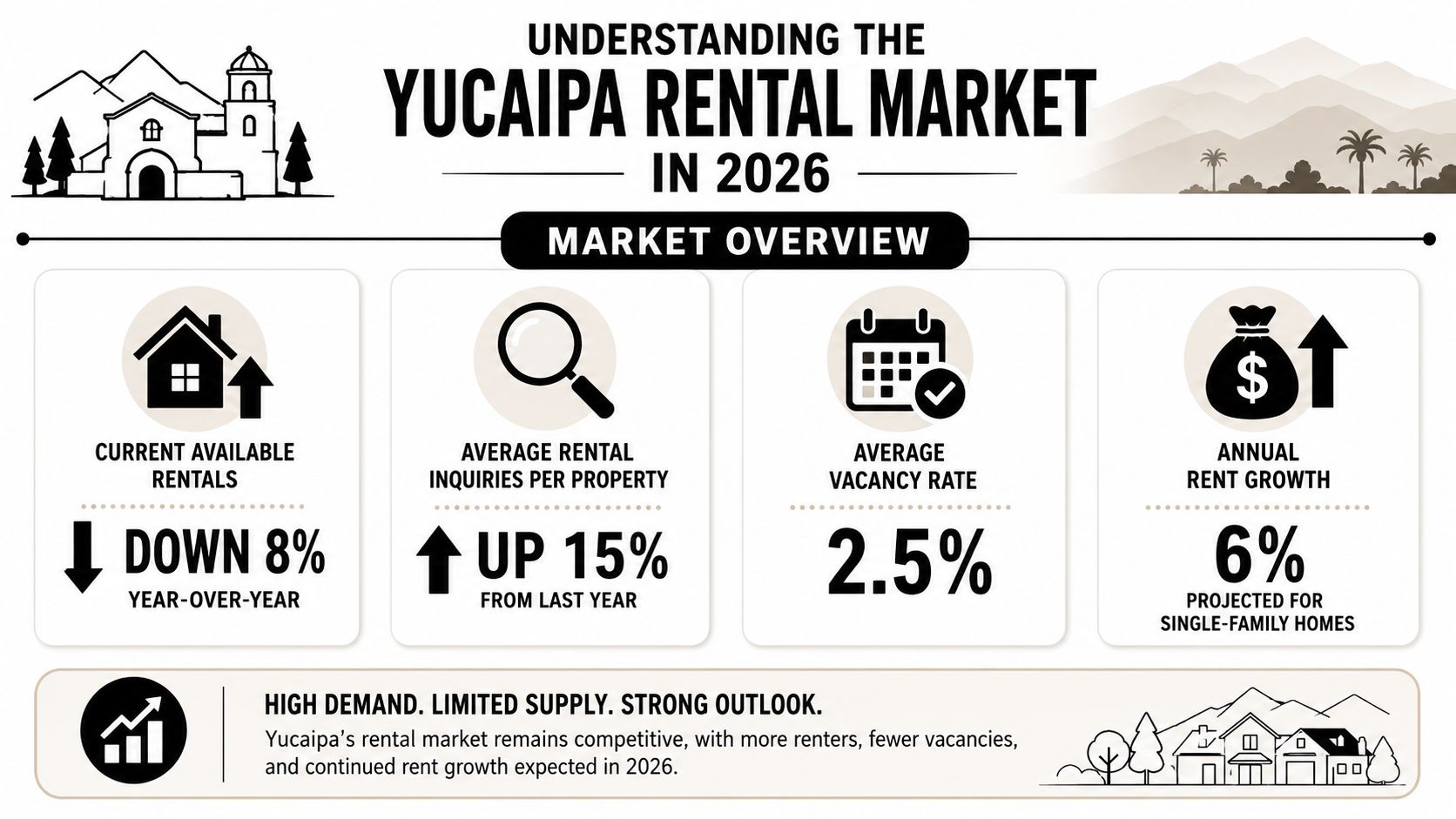
That tighter supply matters because it creates room for disciplined pricing and selective tenant placement. It doesn't mean every house will rent instantly. It means well-prepared homes have a better chance of attracting attention when the condition, photos, and terms are aligned with the market.
What the rent range tells owners
Yucaipa's pricing spread also tells an important story. Verified data shows average house rents around $2,911 to $2,966 per month, while bedroom-level snapshots place 1-bedroom units at $1,641, 2-bedroom units at $2,139, 3-bedroom units at $2,866, and 4+ bedroom units at $3,443 through the same source set tied to Apartments.com and Rentometer.
This isn't a one-price market. A detached rental in Yucaipa can land in very different pricing bands depending on layout, lot, updates, neighborhood, parking, and overall presentation. Owners who rely on one broad rent figure without reviewing house-level comparables usually miss that nuance.
Why this market behaves differently than a large urban rental pool
Yucaipa tends to attract renters who stay for practical reasons. They want room, stability, and a residential setting. That often benefits owners of single-family homes because applicants are comparing more than monthly rent. They're also comparing privacy, storage, yard use, school access, commute trade-offs, and how well the home has been maintained.
A simple view helps:
| Market signal | What it means for owners |
|---|---|
| Modest inventory | Clean, available homes can stand out quickly |
| Wide rent spread | Property-specific pricing matters more than city averages |
| House-level demand | Presentation and upkeep affect leasing speed |
| Family-oriented appeal | Lease clarity and maintenance responsiveness matter more |
The owners who perform best in this market usually don't chase the highest possible ask. They match the house to the right tenant profile and remove reasons for hesitation.
For anyone evaluating Property Management Beaumont, Beaumont property management, Yucaipa property management, property management Yucaipa, Redlands property management, or property management Redlands options, this is the takeaway: Yucaipa supports single-family rentals, but success comes from reading the local submarket correctly, not from using generic rental assumptions.
Strategic Pricing for Your Yucaipa Rental House
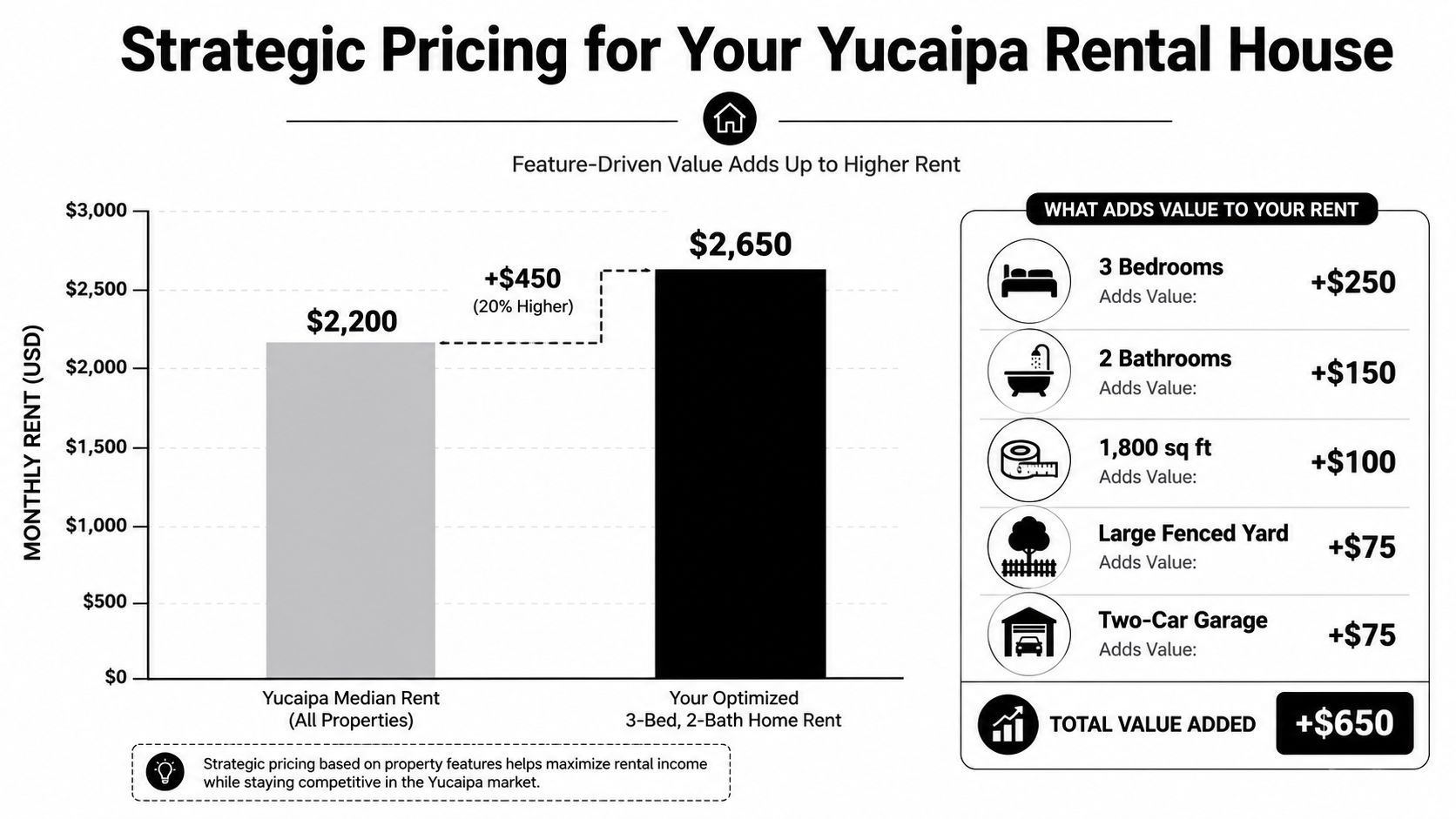
The most common pricing mistake I see is simple. Owners look up a citywide median rent, assume that's the market, and either underprice a detached house or overprice a dated one.
In Yucaipa, that shortcut can cost you.
Verified market data shows the broader city median rent sits around $1,895 to $2,200, while average rents for houses are much higher, around $2,900 to $3,000, based on the market comparison summarized from Realtor.com rental data for Yucaipa. That gap is exactly why single-family owners need house-specific pricing, not apartment-weighted averages.
Price the asset you actually own
A detached home competes against other detached homes. That's the first rule.
If your property has a fenced yard, garage, better kitchen finishes, or stronger curb appeal, those details matter. If the home is older, has worn flooring, or asks the tenant to take on several property responsibilities, that also matters. Good pricing isn't just a rent number. It's a value package.
Here's a practical framework owners can use:
- Start with house comparables, not all rentals. A city median often includes units that are not true substitutes for your property.
- Adjust for condition realistically. New paint, flooring, fixtures, and landscaping change the tenant's first impression.
- Look at friction points. A difficult parking setup, dated bathrooms, or poor exterior maintenance can suppress demand.
- Match the lease terms to the price. If you're asking at the higher end, the property needs to feel lease-ready on day one.
For owners who want a broader comparison tool before setting a number, this guide to average rent prices by ZIP code can help frame the discussion.
A short video can also help owners think through rental pricing and presentation decisions:
Don't ignore the total cost of occupancy
Base rent is only part of what a tenant is evaluating. Owners who price well also decide how utilities, landscaping, pest service, and any other recurring responsibilities will be handled.
That affects both leasing speed and tenant satisfaction. If your rent looks competitive but the tenant later learns they're responsible for more upkeep than expected, the relationship starts with confusion. Clear structure works better than a low headline number followed by vague obligations.
Pricing advice: If a house has premium features, present them clearly. If the tenant is taking on added responsibilities, disclose them clearly. Ambiguity kills good applications.
Yucaipa property management becomes practical rather than theoretical. Proper pricing isn't about squeezing every last dollar from the listing. It's about setting a rent and responsibility structure that attracts qualified applicants and reduces turnover risk.
Securing High-Quality Tenants for Your Property
A good tenant solves problems before they start. A weak tenant creates problems that no rent premium can justify.
That point matters more in Yucaipa because the city has a heavily owner-occupied housing base. Verified housing data shows 18,445 total housing units, with 13,202 owner-occupied units and 5,243 renter-occupied units, based on the source set tied to AirDNA's Yucaipa market overview. A smaller renter base doesn't mean demand is bad. It means owners need to be selective and organized because the tenant pool is narrower.
What a real screening process looks like
Too many owners treat screening like a single credit pull. That's not enough for a house rental.
A serious process checks whether the applicant can comfortably carry the lease, whether their rental history supports the application, and whether their communication style suggests they'll follow the terms. The goal isn't to find a perfect person. It's to identify avoidable risk before the keys change hands.
A practical screening process usually includes:
- Income review. Verify the income source and consistency, not just the number on an application.
- Rental history. Speak with prior housing references and look for patterns in payment and property care.
- Background review. Evaluate whether there are issues that create risk to the property or the lease relationship.
- Application consistency. Compare documents, stated facts, and communication for accuracy.
For owners who want to understand the mechanics in more detail, this breakdown of how to screen tenants is worth reviewing.
Why speed and clarity matter during leasing
Strong applicants don't stay available forever. Owners need to respond quickly, answer questions consistently, and maintain a process that feels organized from first inquiry through lease signing. That's one reason many managers now look at communication systems that help capture and qualify leads efficiently. If you're interested in how firms use automation to maximize website leads with AI, the key lesson is speed and structure, not hype.
A sloppy leasing process repels the exact applicants most owners want. Organized communication signals that the property will be managed professionally.
This is also where service quality separates operators in Property Management Beaumont, Beaumont property management, Redlands property management, and property management Redlands. The market may differ by city, but the principle doesn't. The tenant you place will shape your income stability, maintenance load, and stress level far more than a small difference in asking rent.
Managing Maintenance and Ensuring Legal Compliance
Most rental problems don't begin as major problems. They begin as delays, assumptions, and missing documentation.
A slow roof leak becomes interior damage. A vague repair responsibility becomes a tenant dispute. An informal text exchange becomes a documentation problem when a legal question comes up later. Owners who manage well usually operate with two systems at the same time. They respond quickly when something breaks, and they maintain records and procedures so small issues don't turn into bigger ones.

The all-in cost needs to be defined early
Verified rental market analysis notes that many listings focus only on base rent even though the true cost of occupancy often includes utilities, landscaping, and possible HOA-related obligations, especially when average house rents are already around $3,000 to $3,400 according to the source set summarized from Trulia's Yucaipa single-family rental listings. That same issue affects owners. If the lease doesn't clearly assign responsibilities, maintenance disputes become much more likely.
Clear documentation should answer questions before they arise:
- Landscaping. Who handles it, how often, and to what standard?
- Utilities. Which accounts transfer to the tenant, and which remain owner-paid?
- HOA issues. Who receives notices, and how violations are addressed.
- Move-out condition. What cleaning and restoration standards apply at the end of tenancy.
For owners reviewing responsibility lines, this guide to landlord responsibilities for repairs is useful.
Proactive maintenance protects both income and compliance
Reactive management is expensive because it waits for failure. Proactive management schedules inspections, uses trusted vendors, and keeps records that show what was reported, when it was addressed, and how it was resolved.
That recordkeeping matters during turnovers too. Owners often underestimate how detailed move-out expectations should be. A practical checklist like this one on mastering end of lease cleaning is a good example of how to define standards before the tenancy ends, not after a dispute starts.
Operational insight: Tenants are easier to manage when expectations are written clearly at move-in and reinforced with consistent follow-through.
California compliance adds another layer. Notices, lease terms, habitability issues, and repair handling can't be improvised. Even owners with good instincts get into trouble when they rely on casual habits instead of current procedures. In practice, maintenance and legal compliance are the same system. If you document well, inspect consistently, and respond promptly, you reduce both physical deterioration and legal exposure.
Your Partner in Inland Empire Property Management
Owners with high-value homes usually don't need more information. They need execution.
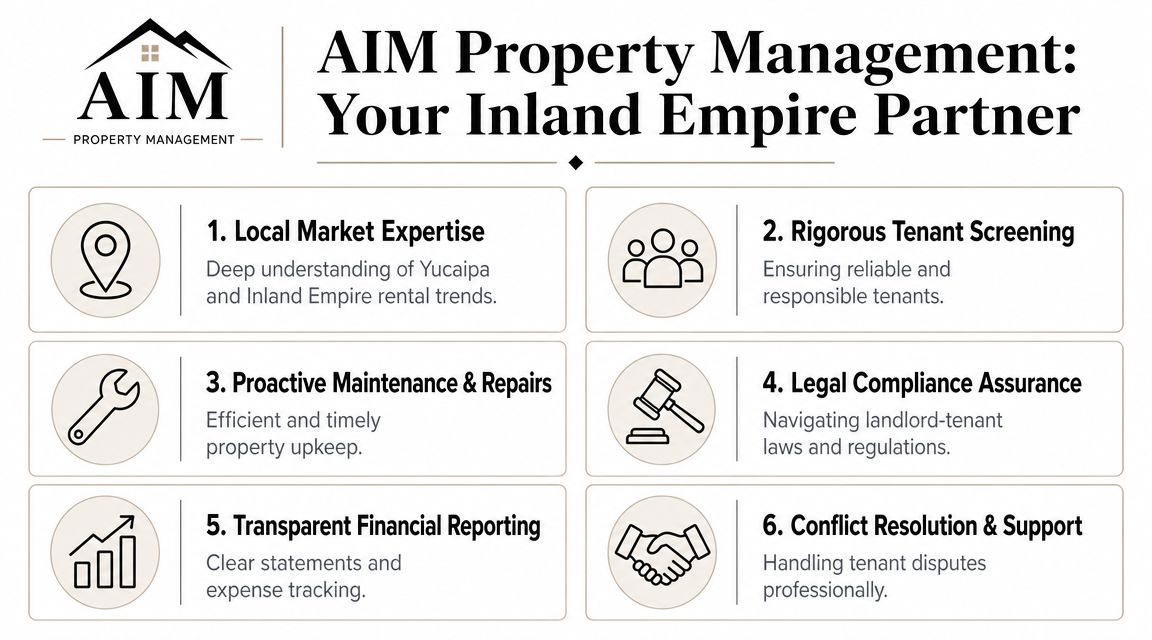
That means tenant screening that is consistent, rent collection that is documented, maintenance coordination that doesn't depend on the owner's availability, and financial reporting that makes the property easy to review. It also means having someone who knows the Inland Empire well enough to understand the practical differences between Yucaipa, Beaumont, Redlands, Calimesa, Loma Linda, Mentone, Highland, and Banning.
What owners should expect from a manager
A capable residential manager should handle the recurring work without taking control away from the owner. You should still make the major decisions. The manager should handle the day-to-day structure.
That usually includes:
- Leasing and placement. Marketing, showings, applications, screening, and lease execution.
- Collection and records. Consistent payment handling and owner statements that are easy to track.
- Maintenance coordination. Vendor dispatch, tenant communication, and repair follow-up.
- Inspections and documentation. Condition checks that support both upkeep and lease enforcement.
- Compliance support. Notices, recordkeeping, and process discipline.
One local option is AIM's Inland Empire property management service, which serves owners across the surrounding communities and focuses on residential properties such as single-family homes, townhomes, condominiums, and investment properties.
Why regional experience changes outcomes
The operational profile of a single-family rental in Yucaipa often overlaps with what owners face in Property Management Beaumont, Beaumont property management, Redlands property management, and property management Redlands. The details differ by neighborhood and property condition, but the core issues stay the same. Pricing discipline, tenant quality, repair coordination, and compliance standards determine whether the asset stays profitable and manageable.
A regional manager with local systems can usually solve practical problems faster because the vendor relationships, communication flow, and inspection habits are already in place. That's what owners are really hiring. Not just a person to answer calls, but a structure that reduces decision fatigue.
You don't hire a property manager just to save time. You hire one to reduce expensive mistakes and keep the property operating consistently.
For owners who want their rental to remain hands-off without becoming neglected, that distinction matters.
Frequently Asked Questions for Property Owners
How do I hire a property manager
Start with process, not personality. Ask how they screen tenants, how they document repairs, how they handle inspections, and how they keep owners informed. When selecting property management near me, focus on whether the company manages homes in your market type and price range, not just whether their office is nearby.
A good manager should explain their leasing standards, maintenance workflow, communication practices, and compliance approach clearly. If the answers sound vague, the service usually becomes vague too.
Is it worth it to hire a property manager
For many owners, yes. Especially if the property is a single-family home and the owner has a demanding schedule, lives outside the immediate area, or doesn't want to stay current on California rental requirements.
The value isn't just convenience. It comes from better tenant selection, more consistent follow-up, tighter documentation, and faster maintenance handling. Those things can protect income and reduce avoidable stress.
What should I look for in a Yucaipa rental management company
Look for local judgment, organized communication, and experience with detached homes. House rentals Yucaipa owners manage successfully usually require more than rent collection. They require oversight of condition, vendors, tenant expectations, and lease enforcement.
Ask direct questions like these:
- How do you set rent for single-family homes
- How do you handle after-hours maintenance
- What happens if a tenant violates the lease
- How often do you inspect
- How are repair approvals handled
Do I still control decisions if I hire a property manager
You should. Owners typically keep control over major decisions such as lease terms, repair approvals above agreed limits, and longer-term strategy for the asset.
The manager handles execution. That division works well because it lets the owner stay informed without having to absorb every tenant message, invoice question, or scheduling issue personally.
What areas do you serve
Owners often ask this after searching phrases like hire a property manager or property management near me. The service area should be broad enough to support regional ownership but focused enough that the manager understands local renter expectations and vendor logistics.
In this market, that often includes Yucaipa and nearby Inland Empire communities such as Redlands, Beaumont, Calimesa, Loma Linda, Mentone, Highland, and Banning. If you own in multiple nearby cities, it helps to work with one management structure instead of juggling separate vendors and systems.
What's the first step if I'm not sure whether to rent or sell
Get a management-level rental evaluation before making the decision. Not a casual estimate. A realistic review of likely rent, property condition, tenant fit, probable responsibilities, and what it would take to make the home lease-ready.
That conversation usually clarifies whether the property supports your goals. Sometimes renting is the right hold strategy. Sometimes the work required doesn't fit the owner's timeline. The key is making the decision from an operational point of view, not just an emotional one.
If you own a rental home in Yucaipa or another Inland Empire community and want a clear plan for pricing, tenant placement, maintenance, and compliance, contact AIM PROPERTY MANAGEMENT COMPANY for a property-specific conversation about your next step.